

Drivers and site selection for Continuous Cover Forestry (CCF)
There are many drivers for CCF, one of them is multi-purpose forestry. CCF manages much better than clearfell and restock to combine production, conservation and social targets.
Drivers for CCF
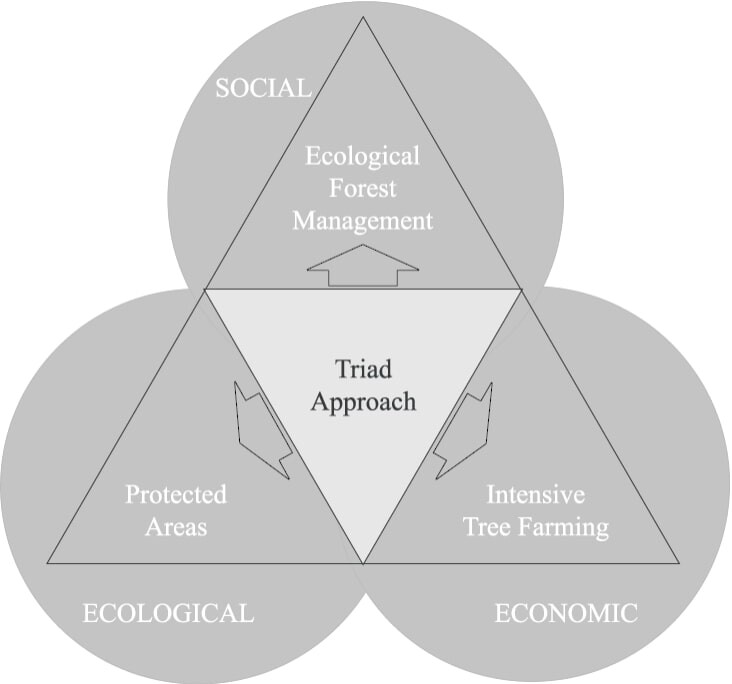
There are many drivers for CCF, one of them is multi-purpose forestry. CCF manages much better than clearfell and restock to combine production, conservation and social targets. After all, timber is one of the most important products of forests but they also have a conservation role, in terms of climate, soil protection and flood prevention, as well as biodiversity. If forests are managed in a more sustainable way, they actually have multiple benefits which are very difficult to measure in monetary terms. The social function of forests is as a backdrop for recreation, for exercise or cultural landscape value. So, it is the multipurpose forestry approach which is a strong drive toward CCF simply because CCF just meets those objectives better.
|
Figure 1. Multi-purpose forestry triangle. Source: Daniel A. Sarr - Forest management, restoration, and designer ecosystems: Integrating strategies for a crowded planet. https://www.researchgate.net/figure/The-Triad-Approach-overlaid-on-the-elements-of-sustainable-forestry-Block-arrows_fig1_232685934 |
CCF forests are usually more diverse, stable in an ecological sense, it is good for forest certifications, if it can be proved that the forest is managed under CCF regime. Sustainability of natural resources, not exposing soil to the elements usually count as one of those as they may help to prevent erosion, and it is embedded in national forestry strategies. Climate change is a big driver where the resilience of forests should be maintained and the risk associated with that should be mitigated. The risk mitigation is usually about spreading the species and age among the trees within the stand but also making the forest structure more diverse and the same is true for pests and diseases.
Site selection for CCF:
The first and foremost question is if CCF suits the site’s management objectives. What CCF can achieve that clearfell and restocking can't on that particular site? The management objectives of the site should be looked at in terms of production, conservation and social objectives. The management objectives usually include the species involved, the stand structure, management goals, the environmental benefits hoped to be achieved, timber quality, social targets, heritage and landscape value. Also, forestry is by nature a very long-term business so that means foresters need to be able to see things through to the end of the rotations. At the moment the site is planted with the species it needs to be clear how that should look when it's ready for harvesting. The final question is would the management objectives be achieved better by CCF or clearfell? If it is CCF, then go for it. If it is clearfell, then the stand may be transformed to CCF in the next rotation period.
|
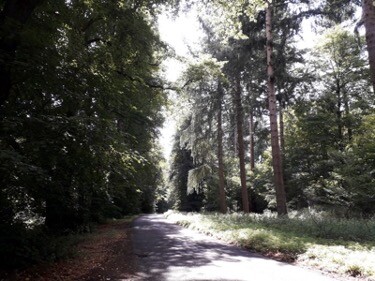
An example of CCF in a public area. Source: Linda Magyar |
Cover forest photo credit: AGNIESZKA WEN from Pixabay