
Water Policy Updates - May 2022
While the number of dams removed from Europe’s rivers reaches its record high, the freshwater boundary exceeds safe limits for the first time according to a study done by the Stockholm Resilience Centre.
Record number of dams removed from Europe’s rivers in 2021
 An increase of 137 % of barriers removed (compared to the previous year) confirms the growing movement and interest in restoring rivers in Europe. A freshly released report by Dam Removal Europe counts at least 239 dams removed in 17 European countries in 2021. A total of 76 % of the barriers were low-head dams and weirs, but 24 % of the total were higher than 2 meters.
Spain is the leading country with 108 structures removed from its rivers, including the tallest dam taken out in 2021 (13m high). The Iberian country keeps removing barriers at an increasing pace, demonstrating once again the importance of a law that enforces the decommissioning of obsolete dams. Portugal, Montenegro and Slovakia recorded their first-ever removal while in Finland a functioning hydropower dam has been dismantled.
Restoring at least 25 000 km of rivers to a free-flowing state is flagged as one of the key elements of the European Union Biodiversity Strategy for 2030, which is part of the European Green Deal. The staggering number of 1.2 million barriers has fragmented European rivers for over a century in many cases. A decline of 93 % of freshwater migratory fish in Europe (Living Planet Index) requires urgent measures and the removal of these obstacles it’s not only necessary for wildlife, but also for a healthier future for our societies. At least 150 000 old, obsolete, and purposeless barriers clog European rivers. It’s clear that we are just at the beginning of a shift towards dam removal, while the topic is still seen as very controversial in many countries.
The outcomes of this annual report will be presented at the 7th Dam Removal Europe seminar “Connected Rivers” in Lisbon (May 19-21), which happens in conjunction with the worldwide celebrations of World Fish Migration Day. Read the report here.
Freshwater boundary exceeds safe limits
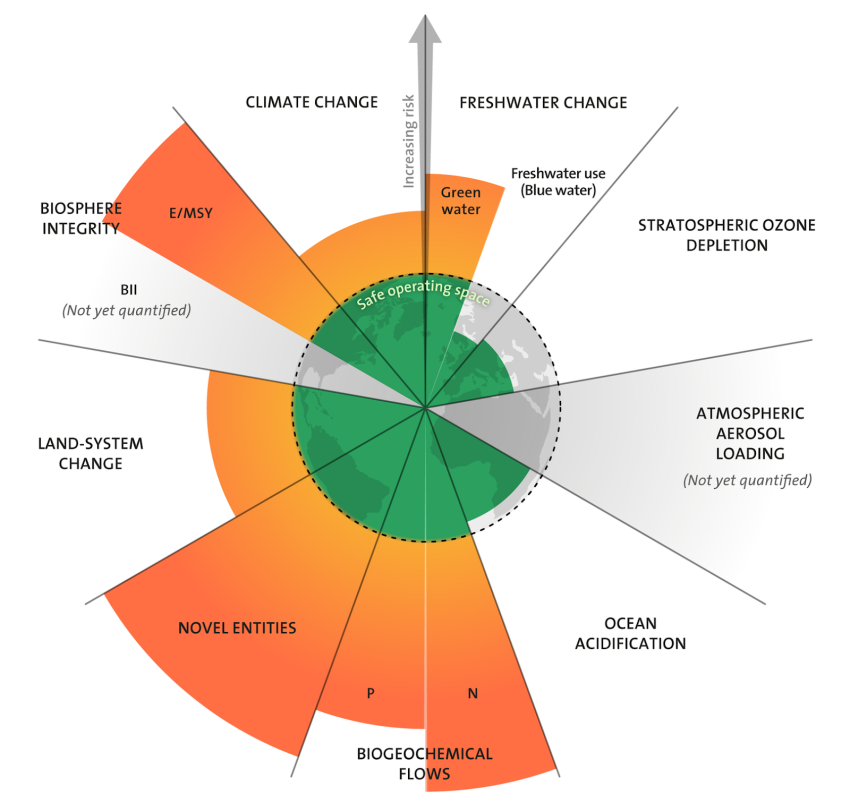
A recent reassessment of the planetary boundaries, conducted by the Stockholm Resilience Centre in collaboration with a group of international researchers, has revealed that we have exceeded the planetary boundary for freshwater. The assessment, published in the journal Nature Reviews Earth & Environment, came to this conclusion due to the inclusion of “green water” — the water available to plants — into the boundary assessment for the first time.
Until now, the water boundary had been considered to be within the safe zone. However, the original freshwater boundary only focused on the extraction of water in rivers, lakes, and groundwater — known as “blue water.” According to lead author Lan Wang-Erlandsson, “Water is the bloodstream of the biosphere. We are profoundly changing the water cycle. This is now affecting the health of the entire planet.” The assessment is based on evidence of widespread changes in soil moisture relative to mid-Holocene and pre-industrial conditions and green-water driven destabilisation of ecological, atmospheric, and biogeochemical processes.
The planetary boundaries framework, published in 2009, demarcates a safe operating space for humanity. Water is one of the nine regulators of the state of the Earth system and is the sixth boundary that scientists have assessed as being transgressed. Other transgressed boundaries are climate change, biosphere integrity, biogeochemical cycles, land system change and, in 2022, novel entities — the latter including plastic and other manmade chemicals.
Now, researchers have explored the water boundary in more detail. The authors argue that previous assessments did not sufficiently capture the role of green water and particularly soil moisture for ensuring the resilience of the biosphere, securing land carbon sinks, and regulating the atmospheric circulation.
The research team proposes that soil moisture in the root zone of plants is a useful control variable for green water. They specifically suggest that the green water boundary variable be defined as the percentage of land where root-zone soil moisture exceeds the historical variability. “Reducing Earth system risks of green water change now requires immediate water-wise actions to address climate change, deforestation, and soil degradation,” says Ingo Fetzer, a co-author of the study and researcher at the Stockholm Resilience Centre.
You can access the full study here.