Karen LaMonte is an American artist who lives in Prague and creates majestic and mysterious works of glass, ceramic, bronze, iron, paper and marble. Her works range from monotype prints to monumental stone sculptures, and she became especially popular with her exploration of the natural world.
“Through my work with climatologists, which started with the development of my original Cumulus sculpture, I learned that carbon emissions drive certain cloud types towards extinction. It was a revelation” she said - and that revelation pushed her to try and make her art sustainable.
“The pandemic further drove home how connected we are as a species, even if we don’t always feel that way. COVID’s global impact compelled me to think more broadly about how my work fits into a global context, specifically: with its carbon footprint.
Making art is my life's calling, and it’s important to me to do it sustainably. I've always done what I could to make my work eco-friendly, like reusing materials and using renewable energy when possible, but I wanted to go further and make my whole process carbon negative. It has turned out to be much easier than I had thought! To figure out how much carbon I needed to offset, I calculated all the greenhouse gasses associated with my work since college, and then doubled that total.”
Karen is working with Cool Effect. Cool Effect is a nonprofit organization that operates a crowdfunding site at CoolEffect.org for buying carbon offsets. The first step in offsetting your carbon is to determine your impact. If you are curious about your carbon impact, you can use this calculator available online.
And now back to Karen. She first calculated her carbon emission. She wanted to know how much greenhouse gas emission she produces based on the type and weight of materials. Because she records all the weights of all her artworks, it was easy to get started.
First, Karen and his husband regrouped all the artworks they have made since college by medium (glass, bronze, ceramic, etc.) and calculated the total weight of each category. Then, they increased the weight by 20% to capture excess materials like containers and waste. Using the Greenhouse Gas Conversion Factors, she calculated the emissions impact of the raw materials.
The main problem she faced was her electricity usage. Glass casting involves holding kilns at high temperatures for a long time, namely over several months. Since she works in the Czech Republic, she used their Default Emission Calculator.
Calculating the emissions from transportation required figures for weight and distance which was all at hand. They decided to calculate the emission total as if she had sent all her artwork by air from Prague to Los Angeles!
Finally, they added up all the miles they had flown since 1997 and used them to calculate the CO₂ equivalent with radiative forcing. Her goal wasn’t merely to neutralize her carbon footprint—she wanted to make it carbon-negative.
So she doubled the total emissions she had calculated. Through Cool Effect, she chose two projects to support.
Art made from trash
You don’t need to be a superhero to save the planet. Art can be your language. Themes about climate change are popping up in our politics, ads, films, books, articles, social media accounts. Talented artists have found ways to make artworks from common trash. Recycled art is about repurposing materials and the underlying message behind all recycled art is in the title itself: recycle. If you take a look at these 40 terrific art pieces you will see them in your trash bin in a whole new way. Alex Andromeda built his three-legged beast from electronic garbage. A dragon was created using aluminum cans by Austinevan.
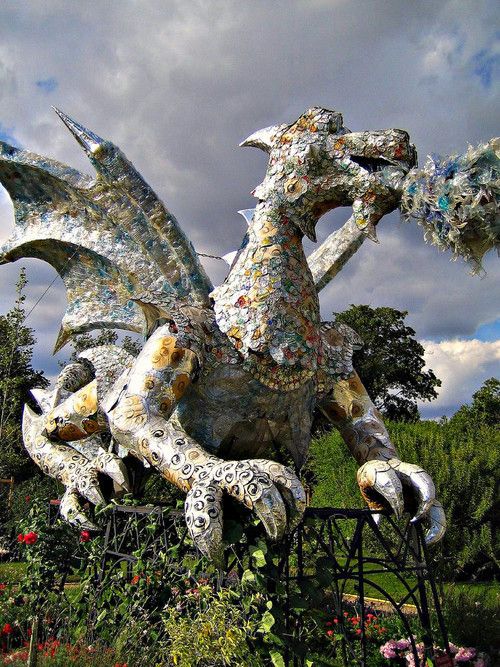
Photo: cc Evan Bench
Maybe you will be surprised to learn it, but the history of repurposing materials to create something new in art began with Pablo Picasso, who invented collage in figurative art. He did paste together different materials: paper, newspaper. Pablo Picasso's "Bull's Head" (1942) is a sculpture made from a discarded bicycle saddle and handlebars. And scores of other artists followed suit. Like Marcel Duchamp or Robert Rauschenberg and the Dadaists. Duchamp's famous art piece is the "Bicycle Wheel''. Max Zorn is a Dutch tape artist who creates artwork from ordinary brown packaging tape - he hangs pieces onto street lamps as a new form of street art at night and his artwork is only visible when the light is on.
Upcycled art
These days, recycling has become essential to protect the environment. It is being practiced in two ways – downcycling and upcycling. Upcycling, also known as creative reuse, is the process of transforming by-products, waste materials, useless or unwanted products into new materials or products perceived to be of higher quality, due to their artistic or environmental value. Upcycling is the opposite of downcycling. This type of art seeks to transform waste such as paper, cardboard, wood, glass, plastics, metals and rubber into works of art. The concept, therefore, goes beyond the conventional recycling of materials by creating objects that exceed the economic, cultural and social value of the original product.
But what is the advantage of transforming trash into art?
Obviously the environmental benefit is that the artists extend the life of the materials, and reduce the amount of waste. Beside giving the materials a second life, art is raising society’s awareness of the consequences of our lifestyle and the importance of recycling.
But you don’t need to be an artist to save the planet. You can still enjoy the pieces of this artist to inspire how to deal with Climate Change? In our private life it is important to learn how to recycle, upcycle, and reduce the trash we produce. Do you have a good idea? Share with us!
More articles about Art & Climate change: