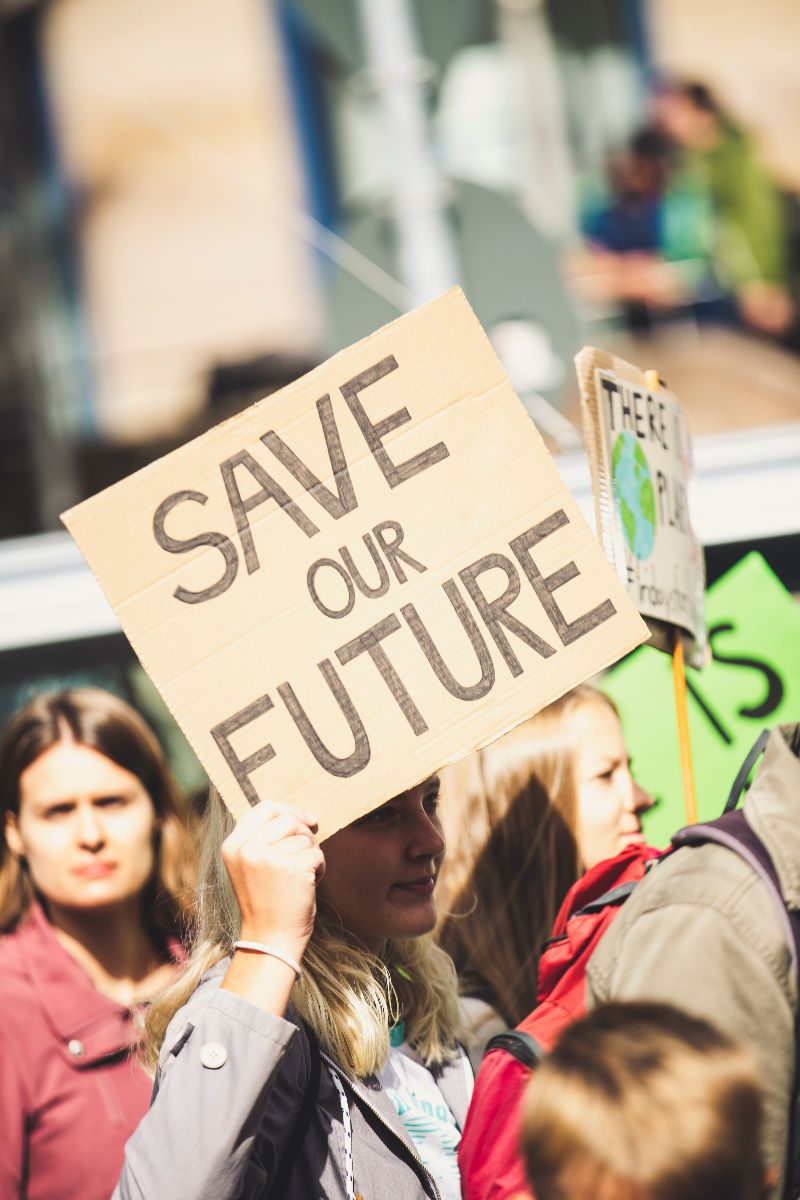
While in the coronavirus crisis less vulnerable young people must help contain the spread of the virus to protect more susceptible older generations, it is the other way round with climate change. The younger generation will have to deal with the effects of climate change in decades to come and is dependent on older generations undergoing a radical rethink and changing their actions. The gravity of progressing global warming is also dependent on the decisions taken now to address the pandemic.
The neoliberal economist Milton Friedman described the significance of crisis for change as follows: “Only a crisis — actual or perceived — produces real change. When that crisis occurs, the actions that are taken depend on the ideas that are lying around. That, I believe, is our basic function: to develop alternatives to existing policies, to keep them alive and available until the politically impossible becomes politically inevitable.”
Not only environmentalists see the potential for change in the coronavirus crisis. Proponents of globalisation, driven by capitalism, also view the crisis as an opportunity. They see it as a chance to water down existing trade regulations and climate and environmental conditions even further.

A generational contract is needed: young people protect old people in the pandemic while the older generation is resolutely taking action against climate change in order to enable the younger generation to have a future worth living in. Photo by: Daniel Tafjord.
Growth, deregulation, and free trade...
In Germany, there are currently numerous examples of this idea, which ignores the boundaries of our planet: the German Association of the Automotive Industry (VDA) urges that the EU-Mercosur Agreement is set in motion during the German EU Council presidency in order to save the automotive industry. The Agreement would result in the removal of trade restrictions for the environment and climate killers such as cars, meat and pesticides. From the perspective of the VDA, the lessons learned from the crisis must be that the EU promotes trade with non-Community countries and reinforces free trade. At the same time, VDA President Hildegard Müller calls for “vehicles with state-of-the-art combustion engines to be included in the scheme” for economic stimulus packages because they are “not inconsistent with the agreed climate change mitigation targets.”[1]
The Federation of German Industries (BDI) calls for the European Green Deal to focus on “the promotion of growth” in response to the coronavirus crisis. The Green Deal will only work “as an investment and growth programme, climate policy must by no means ask too much of companies. It is important that firm action is taken for free trade and multilateralism.”[2] The industry lobby is also up in arms about the Supply Chain Act, with reference to the coronavirus crisis.
The thrust of these ideas is obvious: more growth, the further liberalisation of the global economy and as little interference by the government as possible — apart from state aid payments, that is.
At present, it appears as though the VDA and the BDI can expect political support. Thomas Bareiß, CDU Parliamentary State Secretary for Economic Affairs, rejects a higher carbon price, noting the difficult situation experienced by industry; the EU-Mercosur trade agreement is endorsed by Development Minister Müller, and emission-intensive economic sectors, as the example of Lufthansa shows, are rescued with large sums and without any environmental protection requirements (such as a ban on domestic flights).

The climate and corona crises endanger the young and older generations to different degrees; it must, nevertheless — or perhaps because of that — be thought together and managed. Photo by: Adam Niescioruk.
…or the abandonment of growth paired with social-ecological transformation?
Such policies will exacerbate the climate change crisis. And yet there is a great opportunity to link the two crises together, driving social-ecological transformation. As Dr Steffen Lange (Institute for Ecological Economy Research, IÖW) and Dr Tilman Santarius (Technische Universität Berlin) put it: “From an ecological perspective, we should […] not try to return to the old growth path. […] In view of the urgent need to reduce greenhouse gas emissions, we should not resolve the coronavirus crisis without keeping an eye on climate change, only to then initiate the ecological restructuring of the economy in 2021, or even later.”[3]
One important realisation, according to the French sociologist and philosopher, is that it is possible “in a few weeks, to put an economic system on hold everywhere in the world and at the same time, a system that we were told it was impossible to slow down or redirect”.[4] The handling of the coronavirus crisis seems to indicate that political intervention in the economy might suddenly be possible, which could lead to the long-term abandonment of the growth paradigm and the placing of the common good above economic interests.
It is obvious that emission-intensive sectors such as meat production, aviation and the automotive industry should be called into question first. In concrete terms, this could mean making government aid in the wake of the coronavirus crisis environmentally acceptable. Lange and Santarius make the following demands: “The rescue of airlines must go hand in hand with a radical reconstruction of the sector, including a reduction of flights; assistance for automotive groups should only be available if the combustion engines is abolished.” At the same time, sustainable sectors such as renewable energies and the care sector, which plays such an important — and low emission — role during the coronavirus crisis, must be expanded.
What’s next?
Our handling of the COVID-19 crisis is also decisive as to whether the climate change crisis can be mitigated in the long run. How well we achieve this also hinges on whether society is capable of transferring lessons learned from the coronavirus crisis to the climate change crisis and of dealing with the risk in a spirit of solidarity, in the sense of a contract between generations.
[1]
https://www.handelsblatt.com/meinung/gastbeitraege/gastkommentar-der-staat-sollte-auch-den-kauf-von-autos-mit- verbrennungsmotor-foerdern/25864358.html
[2] https://bdi.eu/spezial/corona/alle-meldungen/#/artikel/news/ein-weiter-so-wie-vor-der-krise-darf-es-nicht-geben/
[3] Futurzwei, No. 13, 2020, p. 23
[4] http://www.bruno-latour.fr/sites/default/files/downloads/P-202-AOC-ROSEN-ALLEMAND_0.pdf