.png)
It is very important to identify the best solutions for the climate crisis in every country. Beside reducing carbon dioxide emissions, it is crucial to increase our capacity to stock and store it.
Today in Romania, as in most countries, there is a tendency to increase the green energy production and at the same time to plant as many trees as possible. Forestation and re-forestation, if not conducted properly, may cause more problems than benefits.
There are countless examples worldwide, when not properly planned forestation actions ruined the CO2 balance of a certain area. For example in Chile, after significant forestation activities (due to the quota transactions), (https://www.nature.com/articles/s41893-020-0547-0) scientists proved that these new plantations do not increase carbon sequestration. Forestation should be carried out in areas with poor carbon stocking capacity. It is also important to use indigenous plant species because, for example, the black locust, due to its special water-management quality dries the soil around the tree, and damages native plant associations (https://onlinelibrary.wiley.com/doi/full/10.1111/ecog.04906).
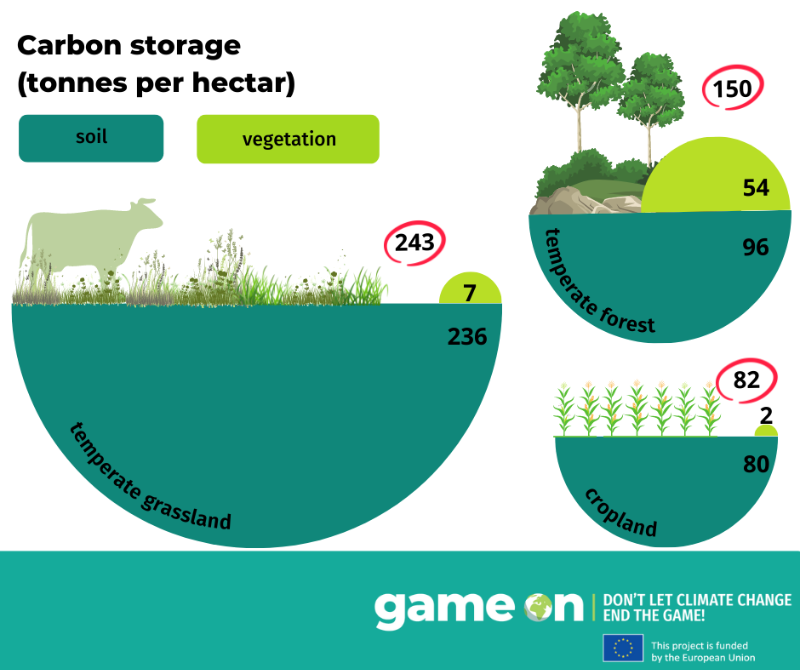
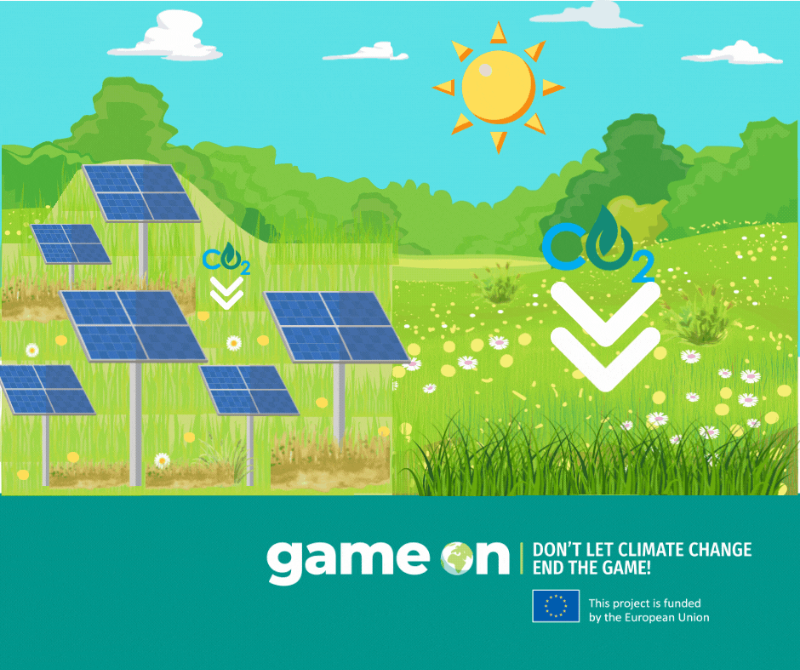
When placing solar panels in natural habitats, it is very important to avoid natural habitats with high carbon stocking capacity. It seems that the Romanian authorities consider grasslands, (which are the natural habitats with the highest carbon stocking capacity), the most convenient areas for forestation and solar panel installation. The grasslands may also be considered useless by most of the population, but this is a totally wrong approach.
Grasslands consist of soft steamed herbaceous plants. These habitats are cultivated for thousands of years as pastures or mowed for foder. Romanian grasslands are extremely important for biodiversity and climate protection (https://climategame.eu/news-article/grasslands-and-their-impact-on-climate-crisis). Their importance from the climate point of view is crucial, because they deposit very high amounts of carbon.
Although this deposition is not as spectacular as in the case of forests, as grasslands have the stocked CO2 deposits not in the plants above the ground, but in the soil. If we disturb the soil of grasslands, carbon dioxide will be released into the atmosphere.
When Romania joined the EU, the country declared that grasslands will be maintained and protected; in spite of these, the grasslands existence l is constantly threatened due to a growing number of factors:
- Changing the land use:
According to the data of FAOSTAT, between 2007- 2019 we lost 46.000 ha of grasslands, despite the fact that plowing them is theoretically forbidden by the law. A study ordered by us, targeting the real loss of grasslands through modeling, shows a five times bigger surface (between 2012-2015, 5,7-9,5% of the grasslands of Romania have disappeared). - Grassland protecting laws can be easily got around, authorities - just like in the case of other environmental laws - are unable to properly enforce them
The existing legal framework cannot protect grasslands by itself. For example, the court rejected a case regarding the illegal plowing of a grassland (Satu Mare county, nr. 343522/2018), because the owner stated the he was just trying to get rid off the ragweed from his land, while in reality mowing could have been as good a solution as plowing. Moreover, even if somebody is forced to rehabilitate the destroyed grasslands, the quantity of CO2 eliminated through plowing will be restocked in the soil only after many decades, and the habitat of many species is gone for many years. Therefore, prevention should gain much more emphasis. - There are law proposals in the Romanian parliament, which are aiming to achieve climate conservation objectives on the detriment of natural grasslandsFor example, the following proposals aim to facilitate the placement of solar panels on grasslands (https://senat.ro/legis/PDF/2022/22b048FG.PDF) and (https://www.agerpres.ro/viata-parlamentara/2022/02/02/video-senat-terenurile-agricole-slab-fertile-de-maximum-50-de-hectare-pot-fi-folosite-pentru-amplasarea-de-parcuri-fotovoltaice--858038).
Due to the disturbance caused by the installment of the solar panels, the schestrated carbon is released from the soil to the atmosphere, and in the same time the biodiversity and the carbon stocking capacity of the area is drasticly reduced. (https://iopscience.iop.org/article/10.1088/1748-9326/11/7/074016?fbclid=IwAR0R_IlrB9SWSIAiVFK8-yRyAGlNydzTX6OmIYC9iN5EbkrgWORTu6nOFL4).Unfortunately, afforestation actions are also regularly targeting grasslands, despite the fact that their carbon stocking capacity is lower than those of the grasslands. - Grassland management is at a disadvantage according to the national agricultural strategy as well. Romania delivered a proposal for the agricultural compensation strategy to the EU (PNS). In this document the country proposes a reduction in the sustainable grassland management facilities as compared with the previous period. Among other entities, our organization protested against this proposal (https://milvus.ro/hu/a-mezogazdasagi-miniszterium-nem-torodik-a-gazdakkal-es-a-kornyezettel/) on national and European forums and we hope, that the EU will request a revision for this strategy.
Where to install solar panels and where to plant forests?
- Green powerplants should be primarily placed in urbanized areas, on building roofs, on functional or nonfunctional industrial infrastructures, on extraneous coal mines or barrens, where natural habitats are nor damaged.
- Bad quality agricultural fields should also be identified, because these are very convenient surfaces to plant forests or install solar panels. Unfortunately, the percentage of those areas, where agricultural activities become less and less cost-effective due to the increasing weather fluctuations, is rising constantly. For instance, without the expensive irrigation, a part of the Romanian Lowland is becoming unsuitable for crop production,.
- Lastly but not least, forests should be replanted in areas which were illegally deforested in the last decades.
Probably, almost nobody would clearcut forests to place solar panels, as suggested by the title. We were willing to highlight that transforming/losing grasslands,may cause as serious (or even bigger) problems for the biodiversity and climate change as losing natural forest.