
EU’s carbon removals and carbon farming certification framework: a new step to incentivize peatland rewetting
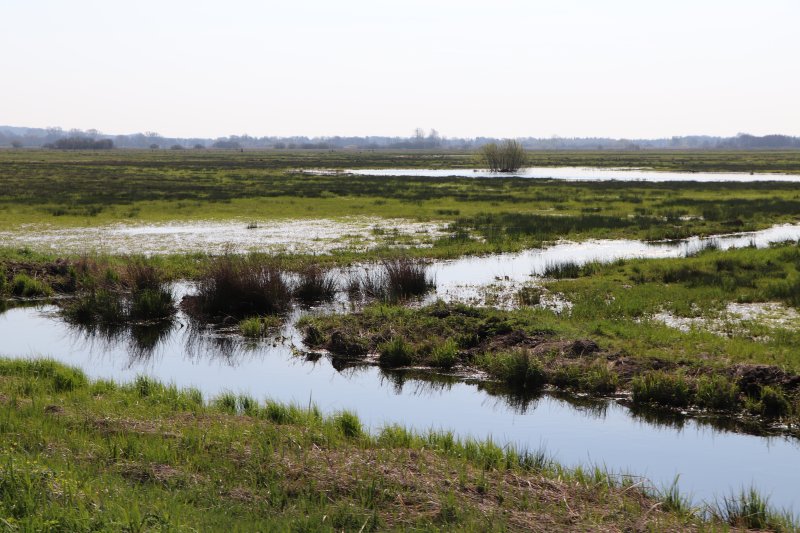
Rewetted peatland in Teufelsmoor Living Lab, Lower Saxony, Germany (photo: Birte Albrecht, Michael Succow Foundation)
This summer was like no other. Across Europe, temperatures soared above 40°C, wildfires devastated forests, and energy crises prevailed. This has been a wake-up call for European citizens, putting them face-to-face with what a warmer world would look like.. Achieving significant reductions in greenhouse gas (GHG) emissions and keeping global warming below 2°C requires action from governments, the EU, businesses and other stakeholders. Peatland rewetting has great potential to support the achievement of this target, but financing this restoration is a significant barrier to progress. The recent adoption of the Carbon Removals and Carbon Farming (CRCF) Regulation represents an opportunity to overcome this financial barrier, opening the door for peatlands to become key climate change solutions.
The past decade has seen an increase in international commitments addressing climate change. Following the signing of the Paris Agreement in 2016, the international community agreed to keep the increase in the global average temperature below 2°C and pursue efforts to limit the temperature increase to 1.5°C above pre-industrial levels1. In addition, EU Member States are required to reach net zero GHG emissions by 2050 under the EU Climate Law2. While these pledges are a step in the right direction, they must be backed by real, on the ground action. To meet climate neutrality by 2050, EU Member States must significantly reduce GHG emissions and, to address unavoidable emissions, increase carbon removals.
When thinking of climate change solutions, ‘peatland’ is not a term that comes to mind for many. Yet these highly diverse ecosystems are a key, often overlooked, solution for climate mitigation. Peatlands are ecosystems with a unique soil known as peat3. Peat is formed when waterlogged conditions create a highly anoxic (oxygen depleted) environment in the soil, preventing the microbial decomposition of dead plants and subsequent release of carbon dioxide. Instead, plant material accumulates to form peat soil, resulting in the storage of organic carbon within peatlands. This storage is far from insignificant. Despite only covering 3% of Earth’s land surface, peatlands store twice as much carbon as forests3. Not only are they considered the most effective long-term terrestrial carbon sinks on the planet, but intact peatlands provide numerous ecosystem services, including water storage and filtration, as well as being important habitats for endemic and endangered species3.
To provide their critical functions, peatlands must be wet. When they are drained for peat extraction, forestry, or agricultural use, oxygen enters the soil and microbes decompose plant material. This decomposition releases previously stored carbon into the atmosphere as carbon dioxide, turning peatlands from carbon sinks into sources. In the EU, for instance, 50% of peatlands have been drained, accounting for 7% of EU GHG emissions3,4.
The state of European peatlands is alarming, but action can be taken. Through rewetting, emissions from drained peatlands can be substantially reduced, helping to achieve EU climate targets. In addition to reducing emissions, rewetting peatlands has clear benefits for sustainability including enhanced biodiversity, decreased flood risk, and the production of innovative products through the cultivation of water-tolerant crops, known as paludiculture3. Considering these numerous benefits, the EU has begun to pay attention to peatland rewetting. Notably, since 2024, EU Member States are obliged to restore and rewet drained peatlands under the Nature Restoration Regulation5. However, financing this restoration has been a significant barrier to progress so far.
The recent adoption of the Carbon Removals and Carbon Farming (CRCF) Regulation represents an opportunity to overcome this financial obstacle. The CRCF Regulation is the first EU-wide voluntary framework for the certification of carbon removal, carbon farming, and carbon storage activities6. The certification essentially serves as an EU ‘stamp of approval’ for these activities. By setting clear standards for certification, the Regulation aims to build trust and stimulate investment in carbon removal technologies and carbon farming practices, whilst also addressing greenwashing.
The CRCF Regulation covers three types of activity: permanent carbon removals, carbon farming, and carbon storage within products. Peatland rewetting falls within carbon farming, which broadly refers to practices that enhance carbon sequestration in terrestrial or coastal environments or reduce GHG emissions from soil6. Under the Regulation, both full and partial rewetting of peatlands are eligible for certification. Certification also covers three other carbon farming activities: agriculture and agroforestry on mineral soils, soil-carbon enhancement on mineral soil, as well as afforestation.
To become certified, carbon farming activities must meet certain quality criteria. These criteria are specified in the Carbon Farming Delegated Act, which complements the CRCF Regulation. The so-called ‘QU.A.L.ITY’ criteria are focused on the QUantification, Additionality, Liability, and SustainabilITY of an activity.
1. Quantification: The net carbon removal or soil emission reduction benefit of an activity must be quantified in an accurate and robust way. To quantify the net removal or reduction, operators must measure the baseline (carbon removals or soil emissions in the absence of the activity), the total carbon removal or emission reduction of the activity, and any emissions associated with the activity, such as fuel combustion emissions from field operations. To gain certification, an activity must have a net carbon removal or soil emission reduction benefit. For peatland rewetting activities, proxy-based (e.g. vegetation type, water table depth) models is the only viable quantification approach.
2. Additionality: The activity must demonstrate additionality. That is, an activity should not: a) already occur due to a legal requirement, or b) be financially viable without certification.
3. Liability: Liability mechanisms address the risk that certified emission reductions are subsequently reversed (e.g. early termination of the activity), particularly where credits are issued upfront based on expected future reductions. However, under the CRCF, carbon-farming units are only issued after the associated emission reductions have been monitored and verified, eliminating the risk of crediting reductions that have not occurred. Moreover, emission reductions from carbon farming activities under the CRCF are not meant to last after the activity period has ended (temporary emission reductions), and are considered released back into the atmosphere at the end of the activity period.Therefore, there is no risk of reversal of certified emission reductions from peatland rewetting under the CRCF, with the consequence that no liability mechanism is needed.
4. Sustainability: The activity must not cause any significant harm to the environment and is able to generate sustainability co-benefits. Peatland rewetting strongly aligns with this criterion, providing many co-benefits including habitat restoration, biomass for paludiculture, and flood mitigation.
Overall, these criteria are meant to ensure the environmental integrity and quality of carbon farming activities.
Once the Delegated Acts have been finalised and published, farmers or landowners will be able to apply for certification. To gain certification, operators must first submit an application to a certification scheme, which verifies that the activity complies with the requirements set out in the CRCF Regulation and accompanying Delegated Acts. Following a successful application, operators are then required to submit an activity plan to an independent certification body for third-party auditing. If this is approved, operators can start their activity, but only after five years (re-certification audit) can they receive CRCF units, which correspond to one metric tonne of CO2 equivalent. CRCF units can then be sold on the voluntary carbon market, allowing farmers and landowners to access results-based payments for their activities.
While the CRCF Regulation represents an important step towards facilitating the financing of carbon farming, certain aspects of its design may limit its suitability for peatland rewetting when compared with established peatland carbon schemes such as MoorFutures. Indeed, since emission reductions from peatland rewetting and other carbon farming activities are considered fully reversed at the end of the activity period, those emission reductions are only delayed in time or temporary, with the consequence that companies can only buy those credits for contribution claims, and not to compensate their unavoidable emissions. This might significantly reduce the attractiveness of such credits, and thus the price of the credits in the voluntary market. In addition, for activities requiring substantial upfront investment, such as peatland rewetting, the fact that CRCF units can only be issued after the associated emission reductions have been verified (ex-post issuance) may represent a significant financial barrier to undertaking such activities. If left unresolved, these concerns may affect the number of operators applying for certification as well as buyers of credits and, therefore, the overall success of the certification framework.
After being overlooked for too long, peatlands are entering the spotlight as important climate change solutions. The CRCF Regulation represents an exciting opportunity to finance peatland rewetting, as well as other carbon removal and carbon farming activities, helping the EU move towards net zero goals. However, many questions remain about the impact of the Regulation, including how many operators will participate, what the monitoring costs will be, and how many buyers will be interested in investing in CRCF credits.
Author: Bethany Thomas (CEEweb)
Edited by: Hugo Hénaff (Michael Succow Foundation) and Eliza Óhegyi (CEEweb)
References
1. United Nations. Paris Agreement. Adopted 12 December 2015, entered into force 4 November 2016. United Nations Treaty Series, vol. 3156, p. 79, Registration No. 54113.
2. Regulation (EU) 2021/1119 of the European Parliament and of the Council of 30 June 2021 establishing the framework for achieving climate neutrality and amending Regulations (EC) No 401/2009 and (EU) 2018/1999 (‘European Climate Law’) [2021] OJ L 243/1.
3. UNEP. (2022). Global Peatlands Assessment – The State of the World’s Peatlands: Evidence for action toward the conservation, restoration, and sustainable management of peatlands. Main Report. Global Peatlands Initiative. United Nations Environment Programme, Nairobi. https://doi.org/10.59117/20.500.11822/41222
4. van Giersbergen, Q., Barthelmes, A., Couwenberg, J., Lång, K., Martin, N., Tegetmeyer, C., Fritz, C., & Tanneberger, F. (2025). Identifying hotspots of greenhouse gas emissions from drained peatlands in the European Union. Nat Commun 16, 10825. https://doi.org/10.1038/s41467-025-65841-6
5. Regulation (EU) 2024/1991 of the European Parliament and of the Council of 24 June 2024 on nature restoration and amending Regulation (EU) 2022/869 [2024] OJ L, 2024/1991.
6. Regulation (EU) 2024/3012 of the European Parliament and of the Council of 27 November 2024 establishing a Union certification framework for permanent carbon removals, carbon farming and carbon storage in products [2024] OJ L, 2024/3012.